Guides
Your Wallet Is Telling Strangers About You
Your crypto wallet may not have your name on it, but that doesn't make it private. Here's what someone can discover from your transactions, connected addresses, and public profiles.
Two wallets. Different addresses. Different purposes.
One holds your savings. The other is the wallet you use publicly, perhaps connected to an ENS name or social account.
You might assume they're separate. But if you've ever transferred funds directly between them, you've left a public connection. Anyone who knows one address can follow that transfer to the other.
And that's just one of the ways your wallets can give away information.
Your wallet address is pseudonymous, not private. Anyone who knows it can inspect its transaction history, see which services it interacts with, and potentially discover other addresses connected to it.
Sometimes, they can even connect that activity to your identity.
The question isn't whether your wallet reveals information. It's how much someone can piece together from it.
Your wallet is a public financial record
Think about how much information is contained in a bank statement: payments, account balances, transfers, regular expenses, and income.
Now imagine parts of that information were available to anyone with your account number.
That's roughly the privacy trade-off of using a public blockchain.
If someone knows your Ethereum address, they can enter it into a blockchain explorer and inspect:
- Your current and historical token holdings.
- Transfers into and out of the address.
- Exchanges, offramps, and crypto cards you've interacted with.
- NFTs you've collected or transferred.
- Other addresses you regularly transact with.
- Patterns in when and how you move funds.
No wallet connection, password, or permission is required.
A single transaction may reveal very little. Several years of activity can tell a much more detailed story.
And unlike most financial records, public blockchain history doesn't simply disappear.
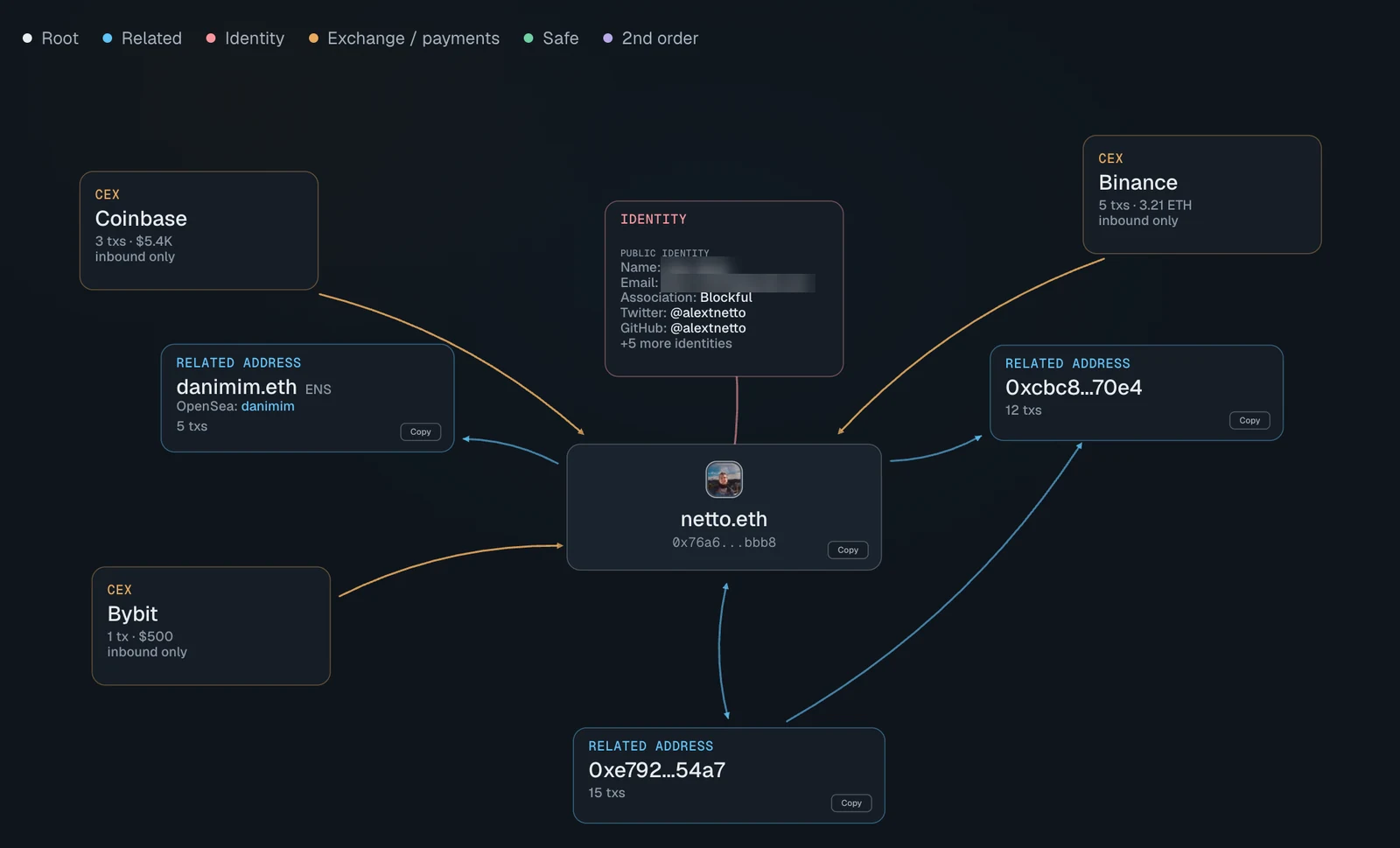
Your identity might already be attached
The most significant privacy exposure often happens outside the blockchain itself.
Consider the ways you might have shared your wallet address over the years.
Perhaps you've registered an ENS name, added an address to your GitHub profile, participated in a DAO, or posted an address publicly to receive payments.
Individually, these actions might seem insignificant. Together, they can build a connection between your online identity and your financial activity.
For example, a GitHub account might publicly list an Ethereum address while also displaying a developer's name, employer, and social profiles. (We cover this in detail in how GitHub can link your crypto wallet to your identity.)
That establishes a publicly visible account-to-address association. It doesn't necessarily prove legal identity or wallet ownership, but it gives someone a starting point.
ENS names and social accounts can expose similar connections.
A clue isn't proof
There's an important distinction between finding an identity-related clue and establishing who controls a wallet.
An ENS name containing someone's real name doesn't automatically prove ownership. A social media mention may be self-reported. A GitHub profile can establish a public association without independently verifying the person behind it.
A responsible wallet analyzer should separate:
- Verified associations: Connections supported by evidence that can be independently checked.
- Self-reported information: Names or identities published by an associated account.
- Weaker signals: Information suggesting a possible connection without establishing one.
Nymis examines publicly available identity signals and provides evidence behind its findings, rather than treating every name or profile as a confirmed identity.
Your separate wallets might not be so separate
Using several wallet addresses is a common way to organize crypto activity.
One address might be public. Another holds long-term savings. A third is used for DeFi.
Keeping those activities separate can be useful for privacy.
But creating a fresh wallet doesn't automatically create a private one.
Imagine you transfer ETH directly from your public wallet to a new address.
The recipient may have no transaction history, no ENS name, and no public identity attached.
Nevertheless, its first funding transaction points straight back to your publicly known wallet.
An observer can't conclude with certainty that you control both addresses. The transfer could represent a payment or something else.
But the wallets are visibly connected.
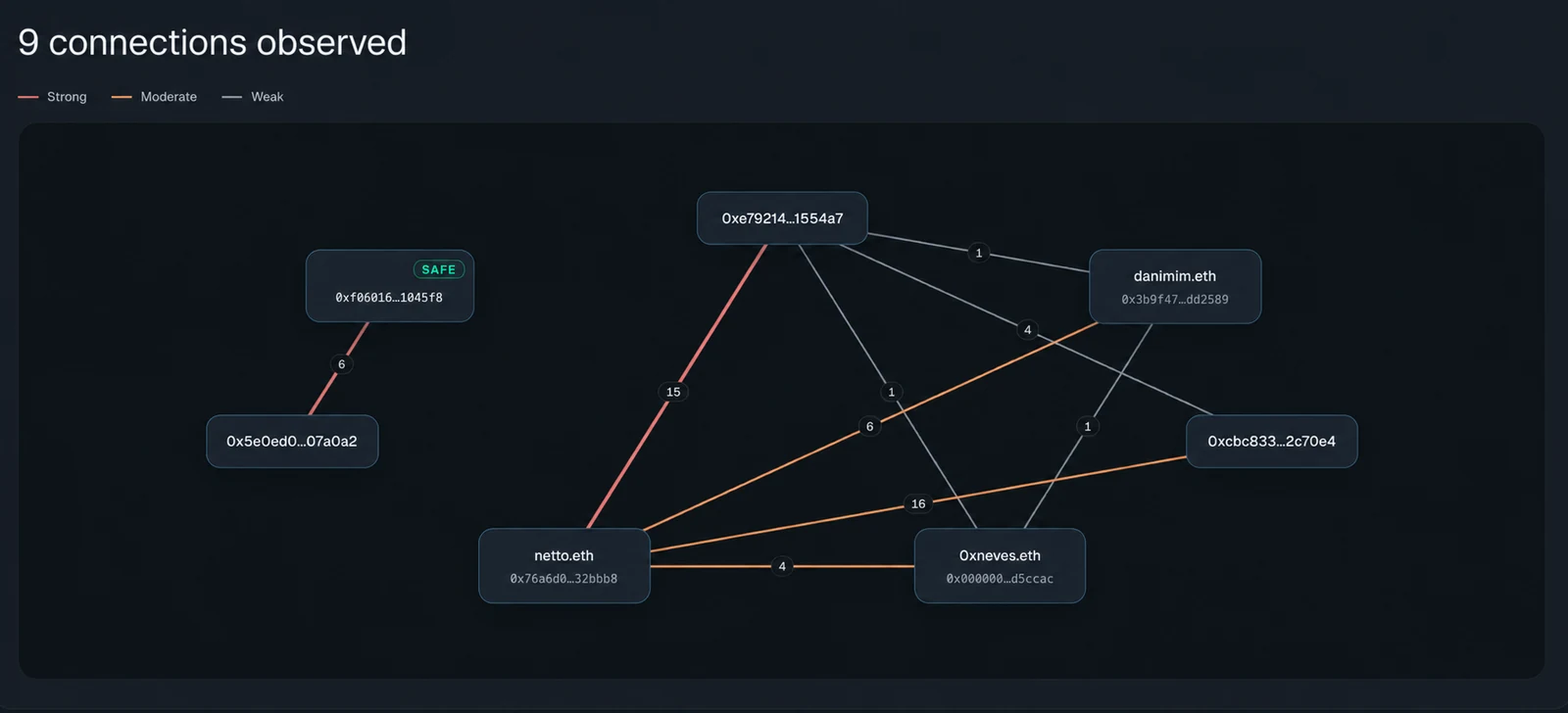
How wallet connections are discovered
| Connection | What an observer can see |
|---|---|
| Direct transfers | Funds moving between two addresses |
| Shared funding | Multiple addresses receiving funds from the same source |
| Shared counterparties | Repeated interactions with overlapping addresses |
| Safe relationships | Publicly visible multisig signer and wallet relationships |
| Identity associations | Multiple addresses connected to the same public account or identity |
The reliability of each connection depends on the context.
Two wallets withdrawing from the same large exchange, for example, are not necessarily controlled by the same person. Shared counterparties are also common across popular DeFi protocols.
A direct transfer establishes a financial relationship, but not necessarily common ownership.
The important question is what the evidence actually demonstrates.
Nymis uses ChainMap to visualize supported wallet relationships and shows the evidence behind them.
You can also use Address Linkage to investigate whether two specific addresses have publicly detectable connections.
Exchanges know more than the blockchain reveals
Centralized exchanges introduce another privacy consideration.
Suppose your wallet receives funds from an address associated with a major exchange.
A public observer may recognize the exchange as the likely funding source.
But the blockchain generally doesn't reveal which customer initiated the withdrawal, who owns the exchange account, or whether the recipient address belongs to that customer.
The exchange itself may know considerably more.
It can potentially associate withdrawals and deposits with account records, identity verification, and internal transaction histories.
This creates two different levels of visibility.
| Public blockchain observer | Exchange operator |
|---|---|
| Can see public transfers and known exchange addresses | May associate transfers with customer accounts |
| Can identify likely exchange interactions | May have access to KYC and internal transaction records |
| Generally cannot see which customer initiated a particular withdrawal | May know the customer's withdrawal destination |
This distinction matters when evaluating wallet privacy.
An exchange interaction is not proof that a wallet's owner has been publicly identified.
However, it can establish a relationship with infrastructure where more detailed customer information may exist.
Nymis reports supported exchange-related evidence while distinguishing what can be observed publicly from what remains unknown.
Your transactions can reveal your habits
Even when nobody knows your name, your wallet activity can expose aspects of your financial behavior.
Consider a wallet that receives a similar payment every month.
Or one that regularly transfers funds to the same service.
Perhaps it moves substantial amounts between particular DeFi protocols, or repeatedly interacts with another wallet at predictable intervals.
These patterns can suggest how an address is used.
For example, someone examining a wallet might observe:
- Recurring payments at similar intervals.
- Frequent interactions with particular services.
- Large changes in token holdings.
- Regular DeFi activity.
- Repeated transfers to specific counterparties.
None of these observations automatically establishes a salary, business relationship, or personal habit.
But patterns can become more revealing when combined with other publicly available information.
For people using crypto for business payments, treasury management, or personal savings, the exposure can be significant.
You don't have to reveal your name to reveal something about your finances.
What a wallet analyzer can—and cannot—tell you
A blockchain explorer shows transaction records.
A portfolio tracker organizes holdings, balances, and performance.
A crypto wallet analyzer attempts to make sense of the relationships and information contained in those records.
For privacy analysis, the focus is different from conventional portfolio tracking.
Instead of asking how much a wallet holds or how profitable its trades were, we're asking:
What could someone else learn about the person or organization behind this address?
Nymis examines several categories of public exposure:
Identity exposure: Discoverable associations with ENS names, public accounts, organizations, and potentially identifiable people.
Related wallets: Evidence connecting an address to others through funding activity, transfers, account relationships, and other supported signals.
Financial and behavioral exposure: Observable transaction activity, service interactions, and patterns contributing to a wallet's public footprint.
These findings are brought together in a privacy report, with ChainMap helping to visualize connections.
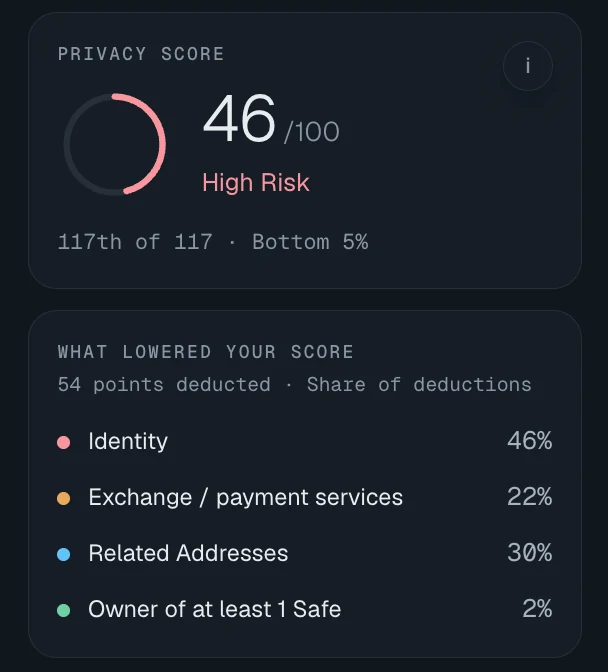
The report also includes a Privacy Score out of 100, summarizing detected exposure across supported categories.
A higher score doesn't guarantee anonymity. A lower score doesn't mean the person behind a wallet has been identified.
Nymis flags incomplete data coverage and marks a score as provisional when those gaps affect its reliability.
The limits of wallet analysis
No wallet analyzer can reliably determine everything about an address.
In particular, public blockchain evidence alone generally cannot establish:
- Who controls a wallet without reliable supporting information.
- Whether two connected addresses belong to the same person.
- The identity behind an exchange's private customer records.
- The purpose of a transaction based solely on its amount or timing.
- Whether every relevant relationship has been discovered.
An absence of detected connections isn't proof that no connections exist.
Understanding these limits is essential. Blockchain analytics becomes misleading when possibilities are presented as established facts.
How to check what your wallet reveals
You don't need specialist software or technical knowledge to begin investigating your own exposure.
Start with an Ethereum or supported EVM wallet address you regularly use.
1. Run a privacy scan
Open the Nymis Wallet Privacy Checker.
Enter your public wallet address or ENS name.
No account registration or wallet connection is required.
2. Examine identity exposure
Look for public accounts, name-service records, or other information that could associate the address with your online or real-world identity.
Pay attention to the evidence classification. Not every reported association is equally reliable.
3. Check related addresses
Review ChainMap and the related-wallet findings.
Are addresses you intended to keep separate visibly connected?
Use Address Linkage to investigate specific wallet pairs.
4. Review your financial footprint
Examine supported exchange interactions and observable transaction activity.
Consider what someone could learn about your financial behavior without knowing anything else about you.
5. Reduce future exposure
Once you understand what's publicly visible, you can make more informed privacy decisions.
Depending on your circumstances, that might involve separating wallet activities, reconsidering public identity associations, or using privacy-preserving transaction methods.
Simply moving funds to another address doesn't erase existing transaction history or guarantee that the new address is unlinkable.
You can use Nymis Shield to explore privacy-preserving routes for moving funds between wallets, including their trade-offs and limitations.
Our Privacy Cheat Sheet explains available approaches and their limitations.
Frequently asked questions
Is my crypto wallet anonymous?
Usually not in the strict sense. Public blockchain addresses are pseudonymous. They don't inherently contain your name, but their transaction histories are visible, and public information may connect them to an identity.
Can someone find out who owns a wallet address?
Sometimes. ENS records, public profiles, social accounts, and other evidence may associate an address with a person or organization. These associations vary in reliability and don't always establish actual wallet control.
Can two wallets be linked without a direct transfer?
Yes. Shared funding sources, public identity associations, multisig relationships, and other supported evidence can reveal connections even without a direct transaction between the two addresses.
Can I delete my wallet's transaction history?
No. Confirmed transactions on public blockchains remain part of their recorded history. You can change how you use wallets going forward, but you generally cannot erase past public transactions.
Your wallet has a story. Do you know what it says?
You may have created your wallet years ago without giving much thought to privacy.
Since then, you've probably interacted with exchanges, applications, people, and other wallets.
Each interaction leaves information behind.
Individually, those records might reveal little. Together, they can form a surprisingly detailed picture of your financial activity and connections.
You don't necessarily need to hide everything.
But you should know what's already visible.